Choosing a Mobile App Advertising Platform for CPI and ROAS Growth
How to choose between search, social and in-app programmatic ad platforms for your app, and how to judge each one on the users it brings in and the revenue they create after the install.

The right mobile app advertising platform depends on where your users are and what you need them to do. Search and app store ads reach people already looking for an app. Social ads reach people by interests and behavior. In-app programmatic ads reach people inside the thousands of other apps and games they use every day. Pick by audience first, then check each platform's formats, budget needs and how well it measures installs, purchases and revenue.
A low cost per install (CPI) can look great while bringing in users who never come back or buy. If your goal is return on ad spend (ROAS), choose a platform that uses post-install events to guide its bidding. Then judge the results by user cohort instead of clicks.
I'm Daniel Ehevich, co-founder and CEO of Playdigo. I judge every mobile app advertising platform by the users it brings in and the value those users create over time.
What does a mobile app advertising platform do?
A mobile app advertising platform connects advertisers who want to grow their app with publishers who have ad inventory to sell. Instead of buying ad spots one app at a time, advertisers use a campaign dashboard to upload creatives, set targeting, set spend limits and watch performance live, from impressions and clicks to click-through rate (CTR) and conversions.

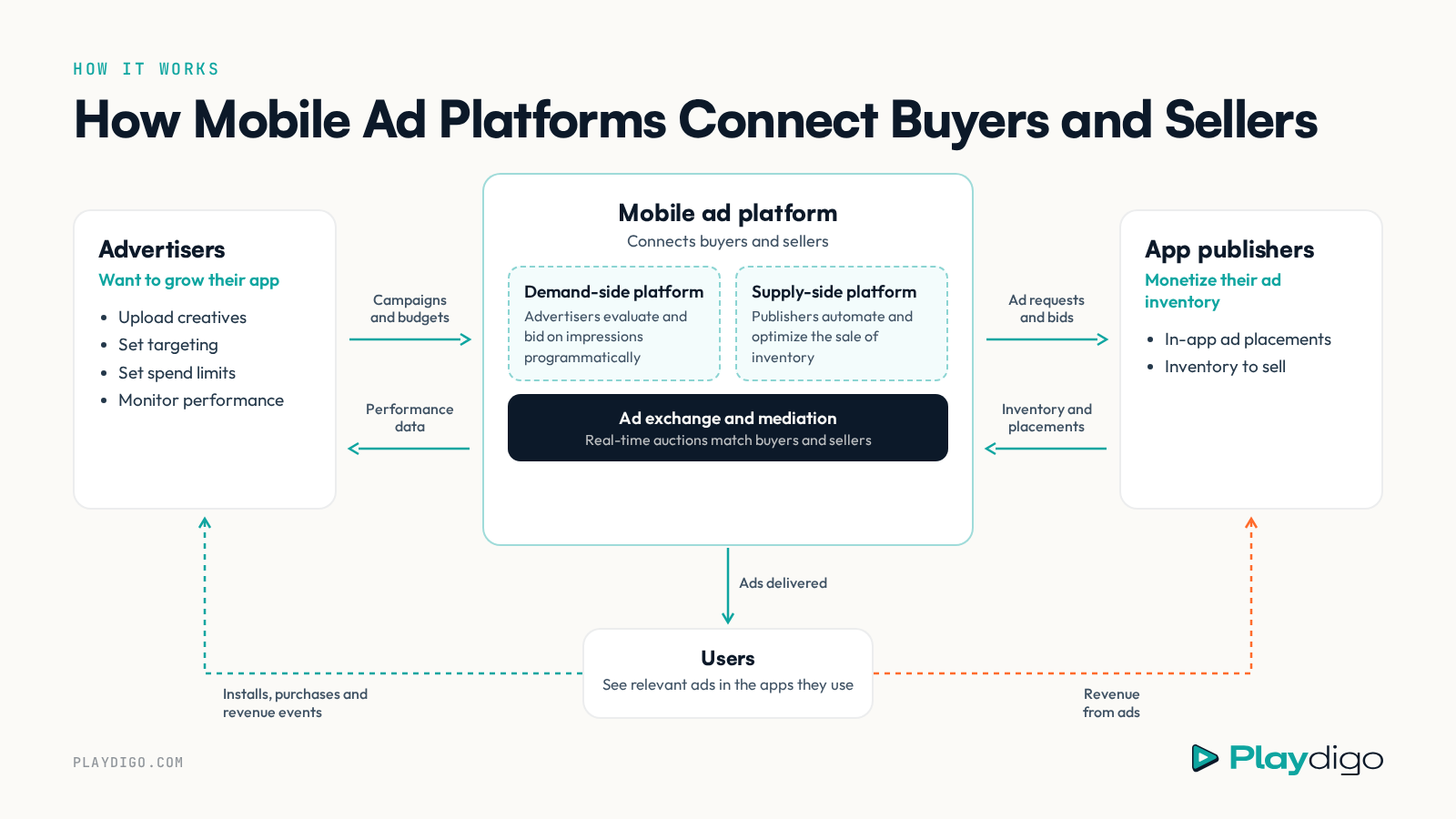
Behind the scenes, programmatic systems match buyers and sellers through real-time auctions. Advertisers use demand-side platforms (DSPs) to evaluate and bid on impressions. Publishers use supply-side platforms (SSPs) to automate and optimize the sale of their inventory.
How does an ad get from the auction to the screen?
When someone opens an app or reaches an ad placement, the app sends an ad request to an ad exchange or mediation layer. That request carries device details, app context and location signals. Four things happen next.
- Ad request. The publisher's app asks for an ad for an open placement.
- Real-time auction. Demand sources bid within milliseconds based on their audience, campaign goals and bid settings, such as cost per thousand impressions (CPM) or cost per click (CPC).
- Ad delivered. The auction picks the winning bid and the creative renders on the user's screen.
- Data feedback. Impressions, clicks and post-install conversions flow back into the system and shape future bids.
Each group gets its own tools. Growth marketers use advertiser tools to launch and optimize acquisition campaigns. App publishers use publisher tools to raise fill rate and revenue per impression.
Which mobile ad formats should you test?
The format you choose shapes your CPI and how people engage with your ad.
- Search ads. Text ads or sponsored app cards in mobile search results and app store discovery when people search specific terms.
- Social feeds and stories. Vertical video and image carousels that run inside feeds and story streams.
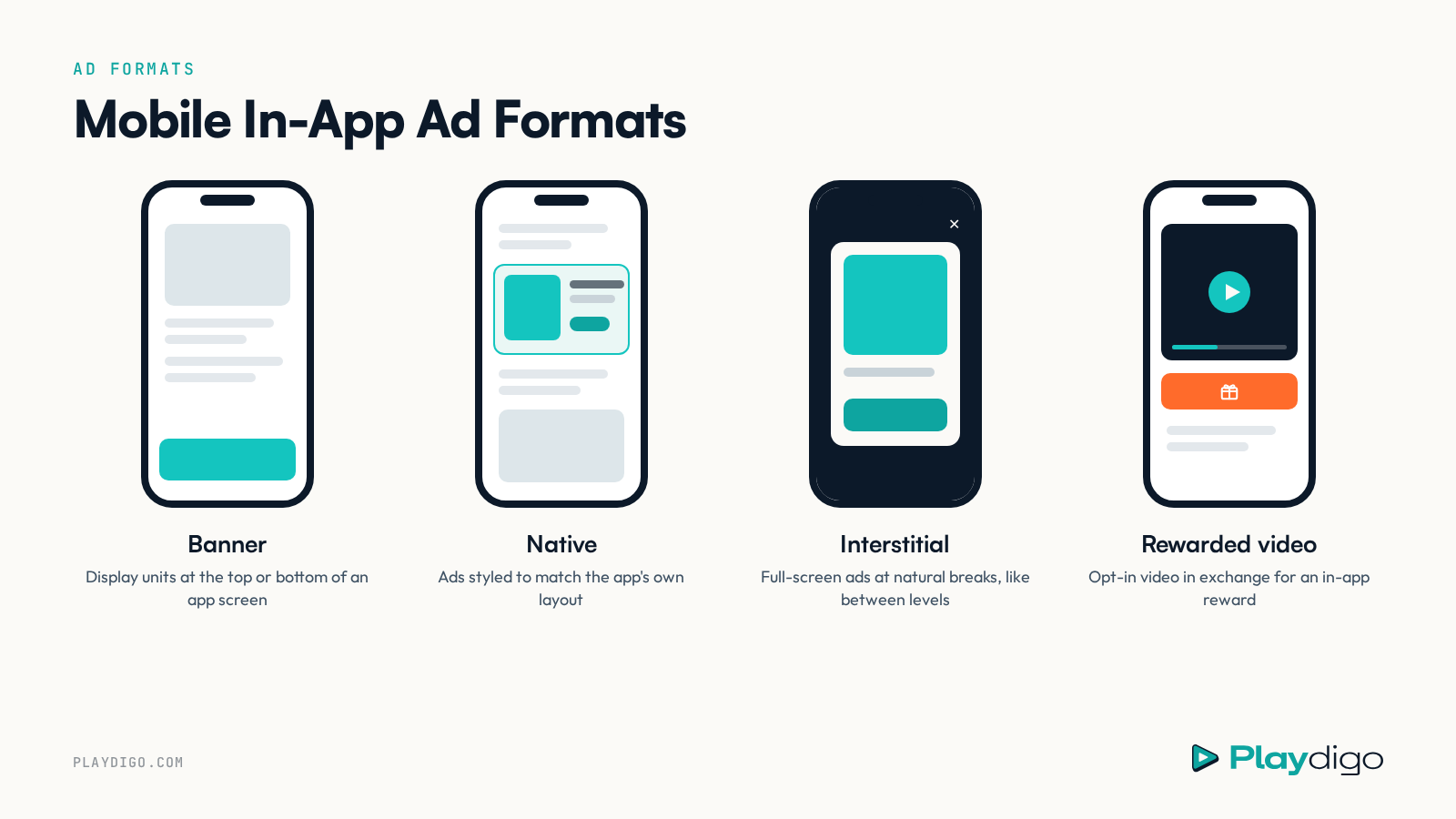
- Banner ads. Standard display units at the top or bottom of an app screen.
- Native ads. Ad units styled to match an app's layout, menus or editorial feed.
- Interstitial ads. Full-screen ads that appear at natural breaks, like between game levels.
- Video ads. Short video creatives that run before, during or after app activity.
- Rewarded video. Opt-in video that people choose to watch in exchange for in-app currency, extra lives or premium content.

How do search, social and in-app programmatic compare for CPI and ROAS?
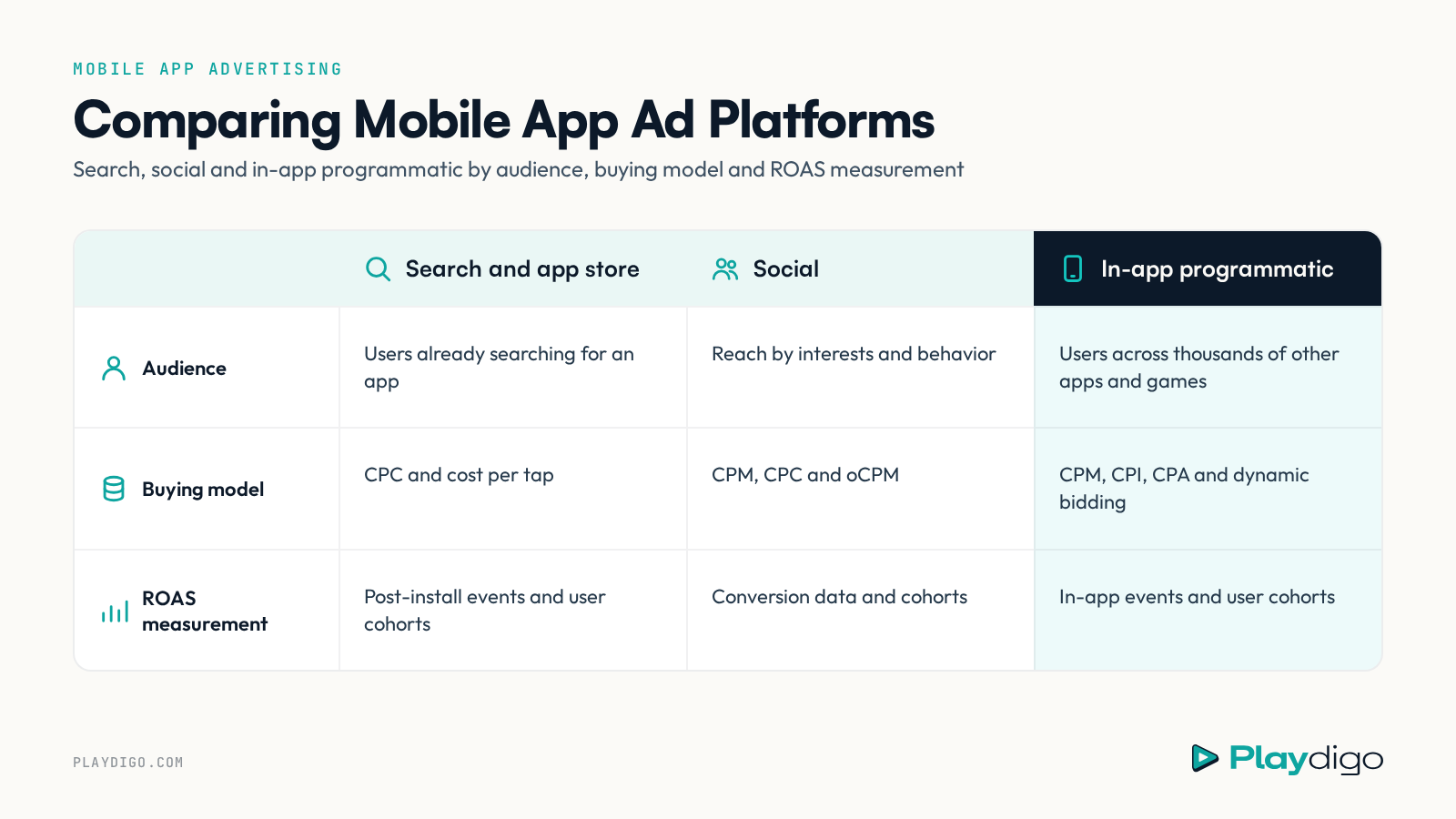
Each platform type reaches a different audience and buys media a different way. Most growth teams run a mix and shift budget toward the channel whose users create the most value.

Search and app store placements
Search and app store placements reach people at the moment they're looking for an app like yours. Intent is high, so conversion rates tend to be strong. The tradeoff is scale. You can only buy as much as people search for, and popular keywords get expensive.
Social and audience-based placements
Social platforms are strong at interest and demographic targeting. They work well for lookalike audiences and for retargeting lapsed users with video and image ads in their feeds. Creative wears out fast here, so plan for frequent refreshes.
In-app and programmatic placements
Programmatic advertising takes your campaigns into the apps, mobile games and utilities people use every day. Through a demand-side platform, you bid across exchanges in real time and serve interstitials, native units and rewarded video to people engaged in relevant apps. It rewards teams that keep testing creative and keep their attribution clean.
How does a platform help you hit CPI and ROAS goals?
Early campaigns often optimize for CPI to build volume. Mature growth teams optimize deeper in the funnel, toward cost per action (CPA), Day 7 or Day 30 ROAS and lifetime value (LTV).
A strong mobile app advertising platform uses real-time event signals to decide what each impression is worth. Instead of treating every auction the same, it predicts whether a user is likely to make a purchase, finish registration or hit an engagement milestone. Our guide to selecting the best DSP for mobile UA covers how to line up your media buying with downstream revenue goals.
At Playdigo, PlayDSP runs that kind of bidding across mobile, CTV, display, audio and web. Our smart bidding tests multiple strategies on every campaign, finds the inventory that returns the most against your CPI, CPA or ROAS goal and scales it without losing efficiency.
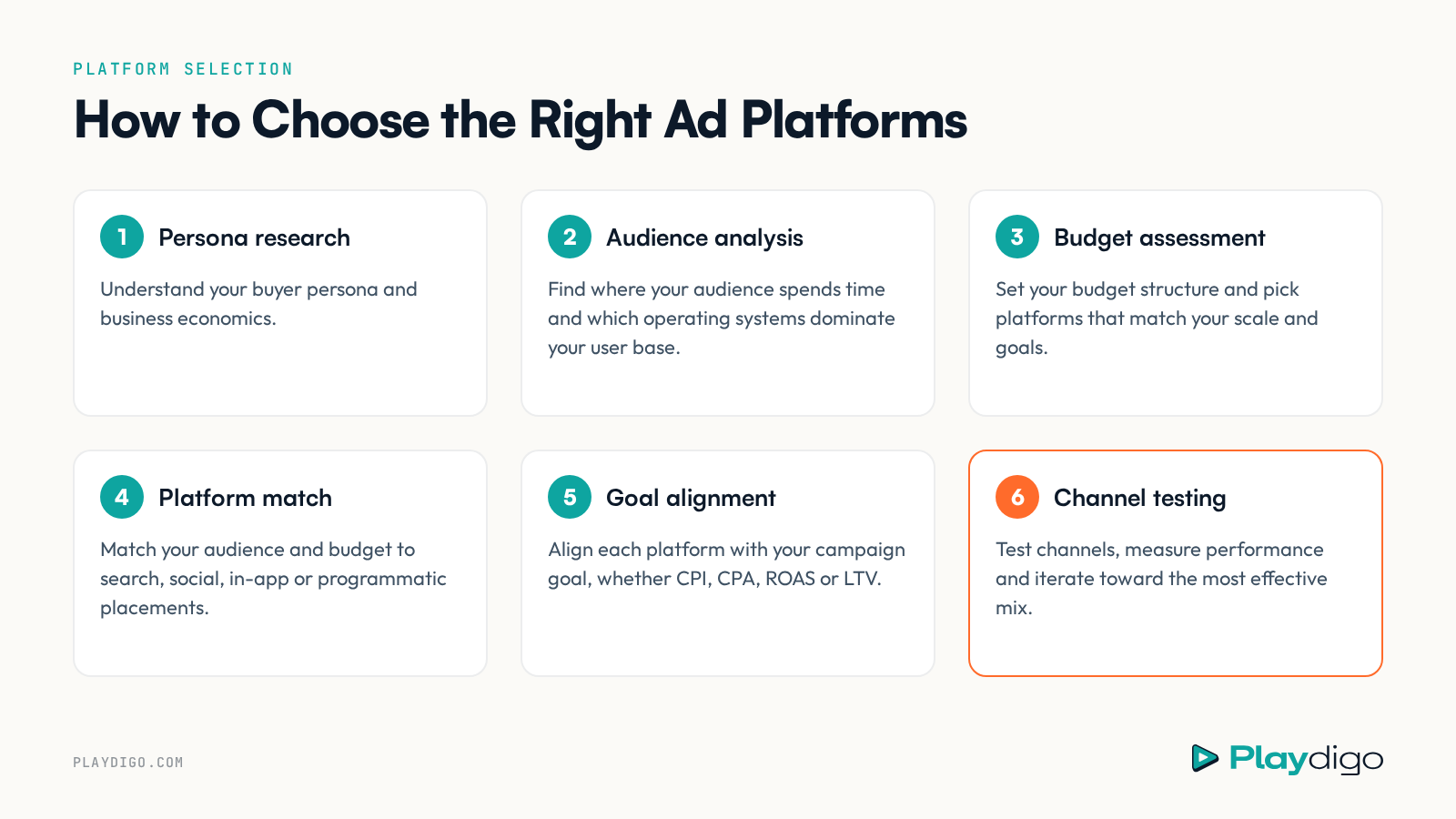
How do you choose a mobile app advertising platform for your audience and budget?
Start with your audience and your business economics, then match platforms to them.
- Where does your audience spend time? Casual gamers, heavy social users and people searching for a specific tool each live in different places.
- Which operating systems lead your user base? Android gives you broad global reach. iOS users often spend more in app, with tighter privacy rules to plan around.
- What does your budget look like? Smaller budgets can start with focused search ads or self-serve networks. Scaling apps need programmatic platforms that can absorb meaningful daily spend without burning through their audience.

What should you check before you launch?
Run every platform through these four checks before you commit spend.
- Inventory quality and reach. Confirm the platform reaches quality inventory in your target regions and app categories.
- Targeting controls. Look for targeting by geography, device model, OS version, connection type and content category.
- Measurement and privacy. Make sure it works with your mobile measurement partner (MMP), supports Apple's SKAdNetwork and follows privacy rules like GDPR, CCPA and COPPA.
- Fraud prevention and brand safety. The platform should filter invalid traffic, click injection and spoofed placements to protect your budget. Our roundup of top DSPs for maximizing mobile user acquisition ROAS shows what built-in fraud controls look like.
For the full list of what to ask on the first call, read Ten Questions to Ask Your DSP Before You Spend a Dollar.
Which buying model fits your campaign goal?
Match your bidding model to the result you need.
- Awareness and reach. Buy on CPM with frequency caps across broad display and video inventory.
- Discovery and traffic. Use CPC bidding on high-intent search platforms.
- Install volume. Use CPI pricing or target-CPI bidding to build your user base.
- Revenue and retention. Use CPA and value-based ROAS bidding to prioritize users who register, complete levels, subscribe or make deposits.
How do you set up, measure and optimize mobile app campaigns?
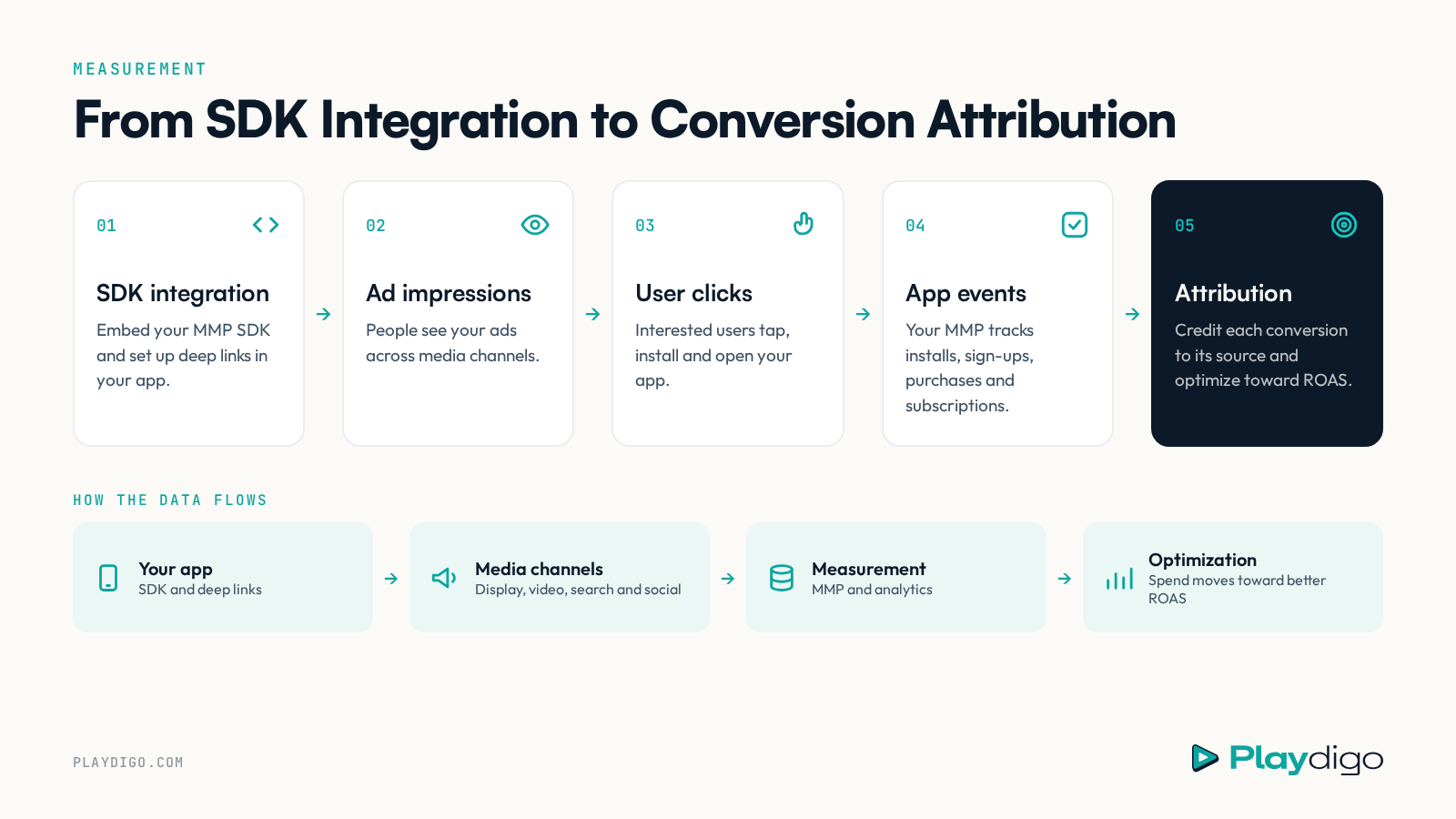
A strong campaign needs a clean connection between your app, your measurement stack and your media channels.

How do you prepare tracking and deep links?
Accurate measurement starts with your software development kit (SDK) setup.
- Add your measurement SDK. Embed your MMP SDK, such as AppsFlyer, Adjust, Singular, Branch or Kochava, into your app build.
- Define conversion events. Map the post-install events that matter, like registrations, tutorial completions, level milestones, add-to-cart actions and purchases.
- Set up deep links and deferred deep links. Installed users should land on the right screen when they tap an ad. Deferred deep links carry new users to that same screen after they install.
- Follow each platform's setup docs. Check event schemas, tracking tokens and API settings against each platform's official documentation.
- Run test installs. Test end to end on iOS and Android devices to confirm clicks, install callbacks and conversion values all register.
For more on building bidding that holds up against fraud, see our guide to optimizing DSPs for high ROAS and fraud-free mobile user acquisition.
How do you measure performance across platforms?
Track what you pay for media and what those users are worth afterward. The IAB's Mobile Application Advertising Measurement Guidelines give you a common framework.
- Media delivery. Impressions, clicks, CTR, CPC and CPM show how your creative and inventory are performing.
- Acquisition efficiency. Install rate is installs divided by clicks. CPI is total spend divided by total installs.
- Downstream value. CPA is total spend divided by the number of a specific action. ROAS is attributed in-app revenue divided by ad spend. Track Day 1, Day 7 and Day 30 retention alongside both.
- Cohort analysis. Compare users by install date and campaign source instead of blended daily totals to see their real lifetime value.
To compare channels across regions, read what user acquisition platforms work for global app install campaigns.
What are the most common campaign problems and how do you fix them?
- Cheap installs that never come back. If a channel drives downloads with no activity after install, move from install bidding to CPA or target-ROAS goals.
- Attribution gaps from privacy changes. iOS privacy rules mean your SKAdNetwork conversion values need careful setup. Incrementality testing shows the true lift across walled gardens and programmatic.
- Creative fatigue. Performance drops as the same people see the same ads. Refresh video and playable creative on a regular schedule and use frequency caps.
- Ad fraud and invalid traffic. Bot farms, impression laundering and click spam drain budgets. Learn how SSPs combat invalid traffic to see how supply-side filters protect your spend.
Frequently asked questions about mobile app advertising platforms
What types of ads can run on mobile?
You can run search ads in mobile search and app stores, feed and story ads on social platforms and in-app formats like banners, native units, interstitials, video and rewarded video.
How should you choose a mobile app advertising platform?
Start with your audience and your main goal, whether that's install volume or downstream revenue. Then weigh your creative resources, your testing budget and how well each platform connects to your measurement stack.
Which metrics show an app campaign is working?
Look at CPI alongside deeper metrics like CPA for key events, Day 7 and Day 30 retention and ROAS. A high CTR and a low CPI only matter if those users go on to engage and pay.
What's the difference between CPI and ROAS bidding?
CPI bidding aims for as many installs as possible at a target cost. ROAS bidding aims for users who generate revenue, so each install may cost more while the campaign returns more.
How to get started
Growing an app profitably comes down to three habits. Pick platforms audience first, keep your tracking clean and judge every channel on the revenue its users create after the install. Search and social give you a strong base. Programmatic in-app adds the scale and real-time bidding that turn installs into long-term ROAS.
If you want to see what that looks like for your app, talk to our team and see what it's like to PLAY with Playdigo.